
Fall 2026
Volume 20 #3
In our current age of the 24-hour news cycle fed ceaselessly by social media, the suffering of people in one part of the world is almost daily eclipsed by the agony of others elsewhere on the planet. In the blink of an eye, the world’s attention shifts from one horror to the next, as if – because it is no longer at the top of our “newsfeed” – the previous atrocities no longer exist or no longer merit our moral indignation. And while the sheer volume of misery and distress reflects tragically on the nature of humankind, the content-driven “reality” that infuses daily life in the West has begun to dictate the information to which we will attend. This, in turn, shapes our worldview; our awareness (or lack thereof) of the truth of the experiences of others.
In that spirit of the search for truth and of movement beyond the day’s news cycle, Ezra takes a hard look here at the torment the war in Gaza continues to bring to the Palestinian people. Despite its relative absence from American news media recently (vis-à-vis other wars and violence in the Middle East), the people of Gaza still suffer profoundly. In this rare double-feature issue, translators Nadine Sinno and William Taggart bring the heartbreaking works of the Palestinian poet Abeer Mohamed to the community of readers of English. In her poems below, Mohamed paints the reality of her experience of the war in Gaza (and that of her daughter, whose illustrations accompany the texts) in searing images that return us to these truths: first, the suffering and violence still rage on in that corner of the world; second, our attention to that reality – to say nothing of our response to it – remains a moral imperative.
Mohamed defines war in terms of her own exquisitely painful lived experiences: “War is not a bomb / It is a piece of shrapnel lodged in a mother’s chest / War is / a hidden grave that wakes up to cries of grief / and falls asleep / in the embrace of a shell with no father / a wedding picture / bleeding under the rubble.” She confronts readers with the theft of her identity and personhood, inflicted upon her by the war and its attendant media coverage: “I was neither a patriot / nor a traitor / I was just a suitcase of exile / On the news / I exist / as a number.” In her poem “The Pit”, the endless violence becomes a kind of liminal space from which there is no escape, as “disaster” sits “on the edge / washing her feet / with streams of blood.” In the guise of advice to the reader, the poet reveals the corrosive cynicism that war breeds – a loss of faith, a loss of innocence, a loss of trust: “Wear the coat of dread, and walk as if you do not crave life. /…Childhood? / A balloon in a field of terror / Safety? / A lie told at bedtime, / before waking up to the tearing of sheets.”
As we have previously seen in Russia’s war in Ukraine (see: Winter 2026 issue, Volume 20, #1), here poetry is once again thrust into the role of witness, of war correspondent. Such works are more than mere vehicles for self-expression. Indeed, they are more than art. They are, in fact, crucial platforms of reporting that defy the dictates of the “content” cycle. They require us to confront our own “consciousness of this suffering world”, as Jaishankar Prashad acknowledges in The Auspicious Dawn of the World (translated below by Chanchala Srivastava). In this sense, poetry and translation play an indispensable role in the future of humanity: for while poems about the continuing war in Gaza are excruciatingly painful to read, like a “narrow darkness crawling over words after words” (see below: Palash Mahmud’s self-translation of Black Dove) only through the truth they convey can we hope to transcend the political and technological forces that perpetuate violence, and that command our attention or (in this case) our inattention to it. Walter Benjamin understood the stakes all too well in World War II:
The destructiveness of war furnishes proof that society has not been mature enough to incorporate technology as its organ, that technology has not been sufficiently developed to cope with the elemental forces of society…Imperialistic war is a rebellion of technology which collects, in the form of “human material,” the claims to which society has denied its natural material. Instead of draining rivers, society directs a human stream into a bed of trenches; instead of dropping seeds from airplanes, it drops incendiary bombs over cities…
Benjamin, Walter. “The Work of Art in the Age of Mechanical Reproduction.” Illuminations, edited by Hannah Arendt, translated by Harry Zohn, Schocken Books, 1969.
Poets and translators are called to be the lens through which humankind sees beyond the surface, beyond the news of the moment, to confront the materiality of suffering that is the inevitable legacy of war. In an interview in 2017, George Steiner framed the Israeli-Palestinian conflict at that time in terms of individual, personal responsibility. Condemning the violence against the Palestinian people, he offered prophetic insights, situating all humans as “guests” of the planet, and describing our fate should we choose to ignore the critical role of intercultural communication in human understanding:
…what convinced me was something Heidegger said: “We are the guests of life.” Heidegger came up with that extraordinary expression; neither you nor I could choose the place of our birth, the circumstances, the historical time to which we belong, a handicap or perfect health. We are geworfen, (italics added) to use the German word, “thrown” into life. And in my opinion, whoever is thrown into life has a duty to that life, an obligation to behave as a guest. What must a guest do? He must live among people, wherever they may be. And a good guest, a worthy guest, leaves the place where he has been staying a bit cleaner, a bit more beautiful, a bit more interesting than he found it. And if he must leave, he packs his bags and leaves. I haven’t visited or lived in any place in the world that hasn’t been fascinating, whose language hasn’t been worth learning, whose culture isn’t worth understanding…The world is incredibly rich. If people don’t learn how to be guests of each other, we will destroy ourselves.
–excerpts from: A Long Saturday, University of Chicago Press (March 8, 2017), printed in The Forward, by Laure Adler, March 27, 2017. https://forward.com/culture/367139/you-really-need-to-read-this-terrific-interview-with-george-steiner/.
In the second of this issue’s double feature, poet and translator Ma Yongbo likewise laments the brokenness of our world in his self-translated poem, Revising the Old Translation of John Ashbery’s Poems on Christmas Eve (see translation below): “this is still a universe full of hostility / cold, lonely, isomorphic to its own ruins…Yet he offers readers real hope for the future, framed precisely in the translationalcontext: “This will not be the final understanding / despite waves recurring time and again, after every storm. Ma acknowledges that writers and translators must live in inconstancy: “The community of the love of writing only temporarily avoids contingency”. It is that very uncertainty, however, that opens us up to dialectical modes of thought which lead to greater literary, cultural, political, and global understanding.
We close with the words of Gabriela Reyes, whose poem Poetry (translated below by Jackie White), situates the power of the art in its role as an antidote for ignorance, for isolation, and for the divisions they breed. And though this particular text looks not at war but at literature itself, history is witness to the speed with which cultural divisions can transmigrate into blinding fear, hatred, and violence. These, in turn, are carefully crafted (politically and technologically) into “immutable” justifications for war. Reyes speaks literary truths which thus have direct application to Gaza, and to all violent conflicts: There is poetry / when the words say more than the author, / and reading reads more than the reader, / and there’s poetry / when contingency rules, is the standard and truth…
May all writers and translators be faithful to that standard of truth. May we acknowledge and be encouraged by the power of our words far beyond their writing, in any language.
NOTES TO COMMUNITY MEMBERS:
- In our next issue, we will critique the use of AI in literary translation. We want to hear from all of you on the question. Please email us a letter to the editor at the following address: ezrasubmissions1+letters@gmail.com. We will publish a number of the letters we receive, in the hope of creating a community-wide constructive discussion on the matter.
- Follow us now on Facebook! Contributors, be sure to check us out.
FEATURED WRITERS / TRANSLATORS : Abeer Mohamed (Translated by Nadine Sinno and William Taggert) and Ma Yongbo
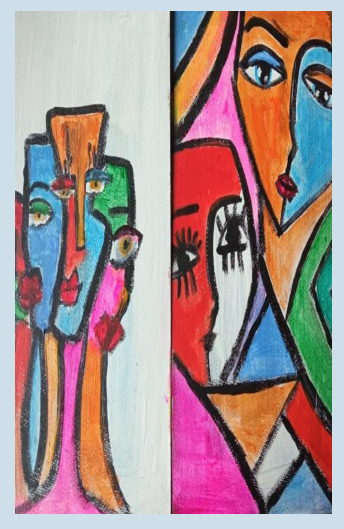
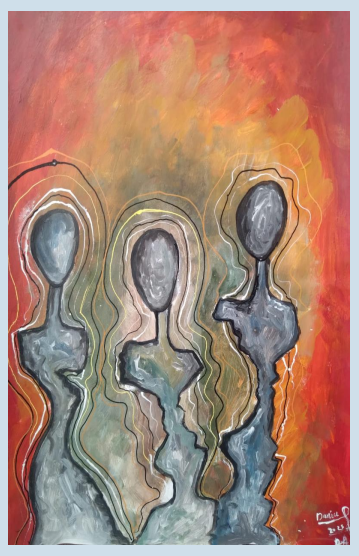
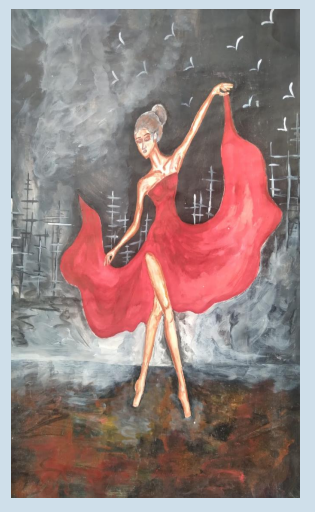
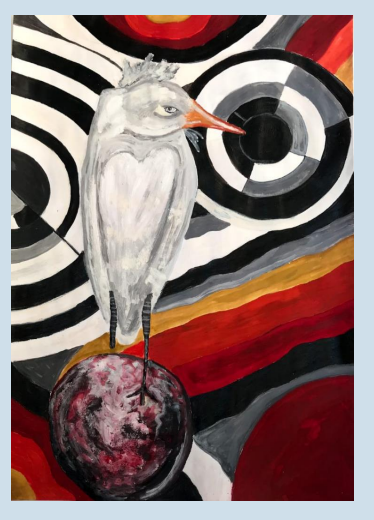
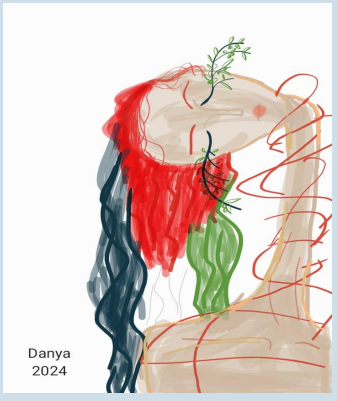
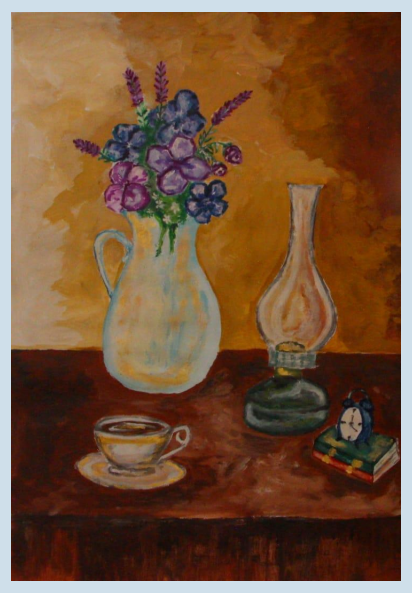
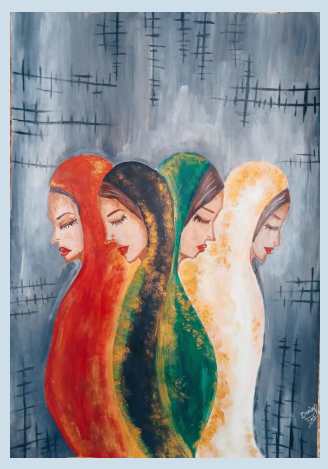
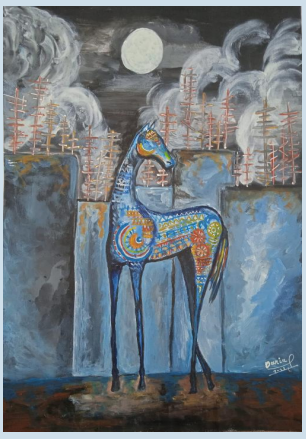
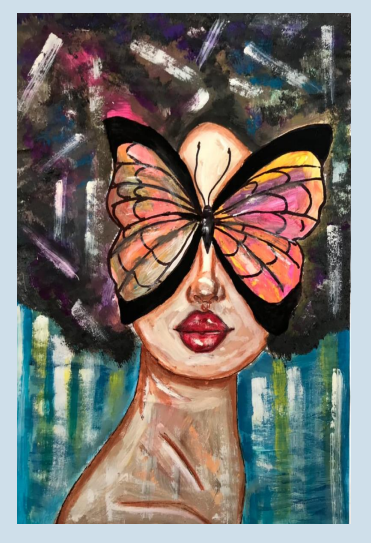
Abeer Mohamed is a Palestinian novelist, poet, and community activist, working in the fields of childhood and human rights. Her work focuses on resistance literature, feminist narratives, and memory writing in war. She is committed to documenting the experiences of women and communities under siege, while exploring the intersections of erasure and survival in the literature of war and displacement. She is the author of the fiction work The Night They Arrested Younes (Al-Ahlia Publishing, Amman, 2023). Her poetry collection Fifty Shades for One War is forthcoming in June 2026 with Éditions Paraules, the Arabic edition of which was published by Wasmha Publishing in Tunisia (April 2026). Below are selected poems from that collection. All accompanying illustrations were done by Abeer’s daughter, Danya Mohamed. Nadine Sinno and William Taggert translated Mohamed’s poems below into English.
Danya Mohamed, daughter of Abeer Mohamed and illustrator of her mother’s works in this issue, is a young visual artist from Gaza, currently studying Visual Arts at Al-Aqsa University after a two-year interruption caused by the war. She is passionate about visual arts and fashion design, with experience in community work with children and youth-led initiatives. She aspires to develop “The Green Company,” an eco-creative project integrating art, recycling, and environmentally friendly products
Born and raised in Beirut, Nadine Sinno is Professor of Arabic at Virginia Tech and a literary translator. Her research focuses on modern Arabic literature and cultural studies, with particular attention to war and visual culture. Her translations include Firefly by Jabbour Douaihy (Seagull Books, 2022, with Paula Haydar), shortlisted for the 2023 Saif Ghobash Banipal Prize for Arabic Literary Translation; Who’s Afraid of Meryl Streep? by Rashid al-Daif (University of Texas Press, 2014, with Paula Haydar); I Saw Her in My Dreams by Huda Hamed (University of Texas Press, 2022, with William Taggart); and Canceled Memories by Nazik Saba Yared (Syracuse University Press, 2009). Her monograph, A War of Colors: Graffiti and Street Art in Postwar Beirut (University of Texas Press, 2024), examines the political and aesthetic significance of graffiti in Lebanon’s capital.
William Taggart is an anthropologist, artist, and translator, whose work explores memory, violence, and social change in the contemporary Middle East. He has conducted ethnographic and visual research in Lebanon and the West Bank, documenting the intersections of art, memory, and public space. With Nadine Sinno, he translated Huda Hamed’s novel I Saw Her in My Dreams (University of Texas Press, 2022). He teaches courses on Arab culture, cinema, war, and research methods at Virginia Tech.
Ma Yongbo was born in 1964. He has a Ph.D in Chinese avant-garde poetry, and is a leading scholar in Anglo-American poetry. He has published over eighty original works and translations since 1986, including 7 poetry collections. He has focusedon translating and teaching Anglo-American poetry and prose, particularly the works of Dickinson, Whitman, Stevens, Pound, Williams and Ashbery. He recently published a complete translation of Moby Dick, which has sold over half a million copies. He teaches at Nanjing University of Science and Technology. The Collected Poems of Ma Yongbo (four volumes, Eastern Publishing Centre, 2024) composed of 1178 poems, celebrates 40 years of Ma’s poetry.
Marked in Red
بالأحمر ممیز
Translated from the original Arabic by Nadine Sinno
and William Taggart
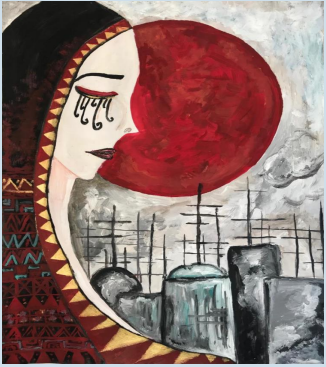
The red of cherries:
It was my dress for the last Eid.
The guns sang over my chest,
and my heart would not flower again.
The red of the heart:
When the poem failed me,
and poetry became a traitor—
writing only in the language of blood.
The red of wine:
I kick a small skull with my foot.
On a shattered table,
I drink a final glass of wine.
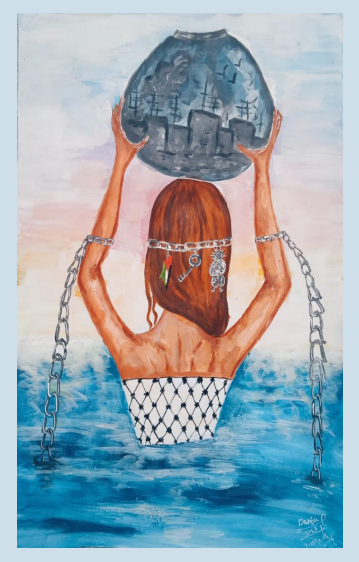
The red of brick:
It was the wall of our house.
It fell, and everything fell with it.
The wreckage remained, its weeping unforgotten.
The red of sunset:
The day I hid from the waves,
looking for a mermaid,
only to find a pirate’s trunk.
The red of flames:
With my eyes,
I saw the city burn.
I did not scream
so the dead wouldn’t hear me.
The red of blood:
It’s not a color, but rather a dark anthem.
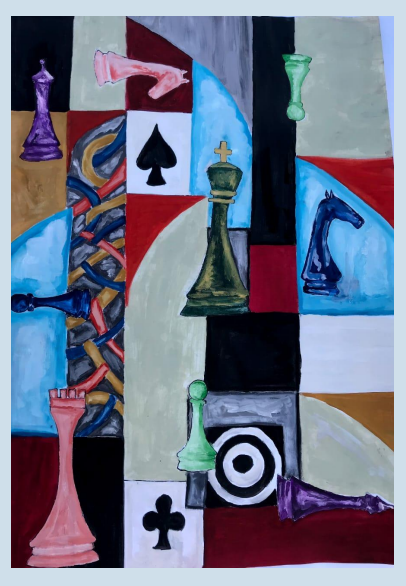
The bride dyes
her palms with henna.
The red of war:
Flags I don’t recognize,
flying over my head,
mocking my name—
redefining defeat.
The red of clay:
When I buried my brother with my hands, and wrote on his forehead,
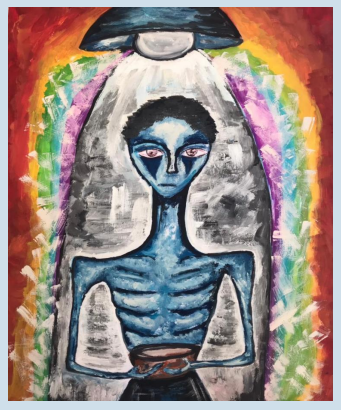
“Brutality began here.”
The red of the Gods:
in epics that remain untold,
where the blood of Abel
still begs the earth.
ABEER MOHAMED
The Pit
الحفرة
Translated from the original Arabic by Nadine Sinno
and William Taggart
No war,
no peace.
We are in the pit.
Where do we go?
When do we return?
The Earth does not remember us,
and the light
only passes through the gaps.
It is untouchable.
It does not warm.
It casts no shadow.
Time flows,
seeping into that which cannot be seen.
The eyes,
a surplus of worry,
and the body,
a text
that holds our pain.
We, and the ashes.
We burn.
We are scattered.
The wind takes us,
We are not extinguished.
We are not laid to rest,
and no one weeps for us.
In the pit,
no prophet,
and no devil.
Just disaster,
sitting on the edge,
washing her feet
with streams of blood.
ABEER MOHAMED
The Wolf’s Commandments
وصایا الذئب
Translated from the original Arabic by Nadine Sinno and William Taggart
Layla does not wear her red dress.
The dress has become a tent,
and the basket is empty,
except for a broken doll
and bread that tastes like soot.
In the forest,
a tireless woodcutter
chops wood every night,
as the skylarks abandon the trees.
The wolf?
He does not hide in her grandmother’s bed.
He roams around peoples’ houses,
watching from behind closed doors,
writing his commandments on the walls’ remains.
Do not walk stripped of secrets.
Every step is a pit.
Wear the coat of dread,
and walk as if you do not crave life.
Do not trust the shadow,
even if it looks like your own.
The pavement memorizes faces,
and hardens against vision.
The grandmother?
No warm refuge,
but a smiling sniper,
a landmine sleeping in an old blanket.
Childhood?
A balloon in a field of terror,
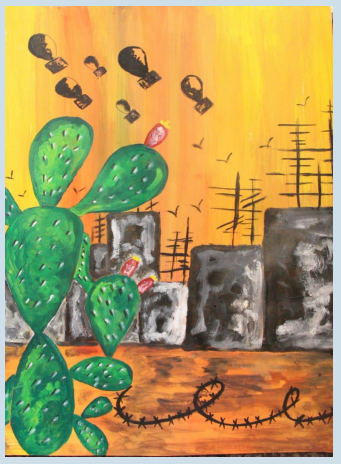
One click,
and dreams are shattered.
Do not fear thunder
in the forest.
It’s a storm beating the branches.
Safety?
A lie told at bedtime,
before waking up to the tearing of sheets.
There is no path home.
From every gap,
a gun hides.
Do not believe the dove.
Peace
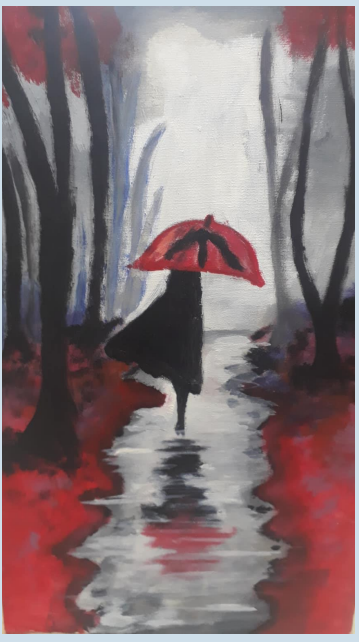
Walks on wooden crutches.
Do not go to the forest.
The forest stretches inside of you.
There is no end to the story.
Layla asks for only one night
that does not kill her laughter,
where she can walk
without stumbling over the light,
without closing her eyes,
without waiting for a wolf every morning.
He stuffs his bag with poems,
he hides sweets between the pages of a book, and he reads on the last page:
Who will tell the next story?
The whole world
is a wolf, Layla.
ABEER MOHAMED
A War of Fifty Colors
خمسون لونا لحرب واحدة
Translated from the original Arabic by Nadine Sinno and William Taggart
1
War is not a bomb.
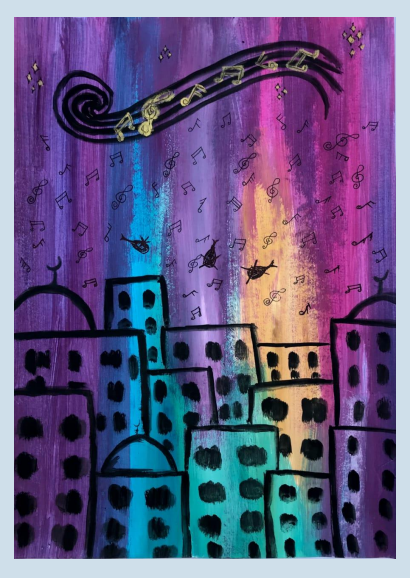
It is a piece of shrapnel
lodged in a mother’s chest,
waiting for a sound.
But no one returns.
2
War is
a hidden grave
that wakes up to cries of grief
and falls asleep
in the embrace of a shell with no father.
3
War is a young girl
applying kohl
in a bomb shelter,
a little girl coloring, with chalk,
a schoolbag,
a wedding picture,
bleeding under the rubble,
a pain leaking
into a bucket of dirty water.
4
War is
a narrow, iron room,
unfit for sleep.
—Holiness
flakes of paint on a wall.
—Prophecies
empty dishes,
and a single cup of coffee
with no scent.
5
In war,
death walks past us
once,
and many times.
Death wears an armor of lies,
takes a look at us,
and does not turn back.
6
In war,
I did not choose death—
it was placed in my hand like a stigma.
I was neither a patriot,
nor a traitor.
I was just a suitcase of exile.
On the news,
I exist
as a number.
7
War
combs her hair,
laughs sometimes,
and sleeps among us.
And every time we try to write about her,
the pen bleeds
salt and blood.
ABEER MOHAMED
She’s No Cinderella
ليست سندريلا
Translated from the original Arabic by Nadine Sinno and William Taggart
A child…and a single body.
The terrible heat of the sun,
ticks away the hours.
It’s noon now,
more or less.
It doesn’t matter…
She’s no Cinderella.
There is no magical chariot,
and the horse is exhausted.
Fear has frozen on her lips.
She was no Cinderella,
holding a white handkerchief
in her small hands.
The shoe…
She lost it under the rubble.
The death-rattle of guilt,
forever stuck in her mother’s chest,
her tears swallowed up by dirt.
There is no magic spell, my little one.
The prince…
He only lives in fairy tales.
Here,
death celebrates wildly,
lifting a glass to victory.
My Shadow is No Longer Mine
ظلي لم يعد لي
Translated from the original Arabic by Nadine Sinno and William Taggart
Yesterday,
when I was young,
I fluttered like a butterfly.
The sea was mine, and the earth was mine,
and I gathered all the clouds in my bag.
In a small boat, with a wooden oar,
I roamed the world,
and hid the waves between my hands.
Just yesterday,
I was spreading laughter,
plucking sunbeams from the day’s face,
and racing against my own long shadow.
Tomorrow, or maybe after tomorrow,
the question will be strange,
and the old man will remain,
waiting for the train to return.
And, I?
I wave for a shadow that is no longer mine.
ABEER MOHAMED
ᔕᔕᔕᔕᔕᔕᔕᔕᔕᔕᔕᔕᔕᔕᔕᔕᔕᔕᔕᔕᔕᔕᔕᔕᔕᔕᔕᔕ
Revising the Old Translation of John Ashbery’s Poems on Christmas Eve
Translated from the original Chinese by Helen Pletts & Ma Yongbo
This will not be the final understanding, despite waves
recurring time and again, after every storm.
Though someone asks you for the key each time
you always hand them more locks.
You can’t live in a museum; you must go out before closing.
Without concentrating the weight of the entire universe
on a needle pointing towards death,
your smile cannot be
peeled off like a label on a willow basket,
leaving a blurry but ever-present residue.
The community of the love of writing only temporarily avoids contingency
its whispers are incomprehensible, but can be felt
as a tremor of a withering disease spreads through wind.
Cold pockets and cold pastorals are mere echo chambers;
the still chaste bride awaits.
This is an opportunity fraught with danger; that outsiders
will occupy the whole house, reverse it to an outline.
Mirrors no longer reflect the self; instead, they layer
others with similar faces deep in the mist of intuition.
You hide the rainbow of words next door
but with a straw, you drain the vitality from this room.
The eternal speed of light that crushes entities
also narrows the gap between past and future,
like a circus horse in a ring of fire;
in the moment of crossing, it solidifies into the present image.
This is still a universe full of hostility,
cold, lonely, isomorphic to its own ruins.
This is still a universe full of chilly promises
because it exists, and I, and the uncertain poetry of you.
MA YONGBO
Fishing at Night
Self-translated from the original Chinese
Distant north, misty bay,
father, with my elder brother and I
settle between the willows by the river.
Water flows over the roots,
torch light shone on the middle of the river.
I was wearing rain boots, on the slippery bank
I felt the cold of the river and the power of the torrent
even from inside the leather boots.
Father kept me nearby
and also away from the river.
A heavy wide raincoat protected me from buzzing mosquitoes.
The Figure of my elder brother was flickering,
as he waited patiently for a small fish.
I forget what my father caught
knowing only that he got something,
he didn’t recognise it either
in the cold wind of a summer night in my hometown.
Loud, bubbling, father’s shadow tall and big
remains still, long behind the willows,
cast upon the river’s surface
by some mysterious shimmer like a broken bridge,
many great stars swim in the river,
I watched the trees behind him, attracted by the darkness,
there was always someone coming, parting the branches.
I have never caught any fish in my life
Whenever I pull the fishing rod, in the dark bottom
my father is wrestling with me, pulling downward,
a thin thread, shaking, connecting us.
MA YONGBO
Father’s Lamp
Self-translated from the original Chinese
The lamp in the courtyard is still on
Over the fence, morning glory is climbing hard
White paint like cracking skin, on a wooden table
Scattered with pale pods and tears
It’s autumn, one autumn of all autumns
Pockmarked potato pile before the window
Darkness has long occupied the house, dark but warm
And silence, weak scent of ashes
Breath of the family floating like ghosts
I’m awake in darkness, waiting for something
This is father’s autumn, his knuckles thicker
Remains silent,I hear creaking of the rocking chair
By the window, father has risen and left
Darkness of his body is shaking alone
He stands alone in the courtyard
Looking up at the stars and faint path over tree top
In the can beside the fence, a candle kept burning
Father’s autumn, his heart contains more than us
Perhaps reaching a certain age, one will have
this concern as something of one’s own
When did father step on that shining path
in darkness, nobody knows
The lamp he left kept burning
The days are lengthening, that autumn seems forever
Christmas morning,2016
MA YONGBO
traduttori/traduttrici
Jackie White ( Gabriela Reyes )
Eric Daffron ( Abdellah Taïa )
Palash Mahmud ( self-translation )
Shilyh Warren ( Ana Lamela Rey )
Chanchala P. Srivastava ( Jaishankar Prasad )
The Photo
Translated from the original Spanish by Jackie White
On his pony, in the country. A precocious little boy
who, they say, revived birds and wing-damaged insects,
and kept a box of clacking bones.
That little nose full of sunshine
I knew as aquiline: my horizon in the shadows.
That hand on the reins, the hand I was going to love,
and those eyes, they haven’t changed.
Today, finally, I know that life is only
a long and unsteady way of perfecting solitude.
I take possession of your photo,
of that afternoon from your childhood, and many others.
I mean to be where I wasn’t,
to know what I don’t know, I want to invent
a hospitable story,
one that I can enter. A story of you that would be
my home, my secret city, my resting place.
GABRIELA REYES
Loneliness of Language
Translated from the original Spanish by Jackie White
Loneliness of language, its multiple resonances
of forsaken contexts. I say some word or another, a poor word,
I say, “stone,” and so much is said it overwhelms my memory.
You were my companion
because you companioned me with words. You’ve gone
and only the words accompany me.
GABRIELA REYES
Poetry
Translated from the original Spanish by Jackie White
There is poetry
when the words say more than the author,
and reading reads more than the reader,
and there’s poetry
when contingency rules, is the standard and truth
and one woman is all women, and none,
as I am when I write
so that of all those who read me
you’re never one.
GABRIELA REYES
The Cats of Hay Salam
Translated from the original French by Eric Daffron
You’re a cat, Abdellah.
G. P.
There have always been cats in our neighborhood, Hay Salam, cats of all colors, yellow, black, gray, and even multicolored. We would also come across Russian cats, that’s how we called them, I don’t know why, clean cats with well-kept fur. (They were rare and rapidly became as dirty as the other cats.)
The cats of Hay Salam belonged to no one; they lived with everyone, and of course, in the streets. They were free and never let themselves be domesticated, even if sometimes they gave the impression to the contrary. They remained forever wild.
Where did they come from?
Enigma always without answer, without solution. They were there one fine morning, in the neighborhood; we recognized them by dint of seeing them before the front doors of houses each night or each afternoon, that depended: to each cat its schedule and its favorite house (or houses).
In our house, we had many of them; they dropped by, they followed one another. Families and families of cats. The family I remember the most consisted of three cats.
First, the gray female cat who, to begin with, preferred the neighbors’ house, before taking up ours as a more or less fixed residence. She became frequently pregnant, but I never saw her kittens. I thought they died just after birth, before my sister Rabia revealed to me the horrifying truth: “Mais elle les mange ses chatons, she eats them, you understand?” No, I never understood. Why then did she eat them? None of my close friends or relatives at the time could give me an answer, or it was only a sketchy answer; on the contrary, they assured me the myth was really true. Troubling. Those poor kittens!
But one time, a miracle happened. The gray cat managed to keep one of her kittens, a blond. She was evidently no longer hungry when his turn to be devoured arrived: she spared him. The blond cat narrowly escaped. A survivor!
Very quickly, he grew, becoming as he got older more and more handsome. He was the only all-blond cat in the neighborhood—my mother, M’Barka, nicknamed him “the yellow cat.” Besides that distinctive title, he seemed less wild than the other cats, ready to live faithfully in the same house, ours, provided that we fed him regularly, which I did without forcing myself too much. (As reward, he let me caress him, and even sometimes scratch his head.) In the end, he was, in appearance only, a real domesticated cat, but from time to time his wild side came out again, notably in spectacular brawls with the other cats (most often for a female or for food): I didn’t recognize him anymore. He showed in this way his true nature. Which didn’t displease me. I even went so far as to rile him to reveal his hidden nature, to get him to throw off his mask, at my own risk: he scratched my hands many times, luckily never my face.
I took pleasure in knowing he lived with us, dependent on us, privileged spectator of our private lives. I liked seeing him seated, crouched, grooming or exercising. He had a natural elegance, an extraordinary suppleness, something extremely fine. Nice, but not too much. He remains associated in my memory with numerous family events, the serenest with the stormiest, to which he was discreet witness. He was there, among us, he had a place. He sometimes of course disappeared for long periods of time, three or four days, not more: he was unfaithful to us; by that, we had to understand that even if we fed him, he was free and could easily find elsewhere what we offered him. That was something of a warning.
He almost never meowed, which was surprising for a cat. Was he mute?
A year after his coming into the world, his mother, the gray cat who sporadically made cameo appearances, gave him a sister, a black cat who didn’t resemble him at all. Who was her father? The one-eyed cat? The fish merchant’s cat? Unless it was the phantom cat the whole neighborhood spoke of but we not had really seen but one time? I was puzzled: no way to satisfy that curiosity.
As soon as she put her into the world, the gray cat disappeared forever, leaving the black cat to the care of her brother, who looked after her very well: she accompanied him everywhere. I didn’t like her. She was black, and that color alone sufficed to classify her among the undesirable cats because they’re possessed by the devil; we didn’t like them, but we didn’t dare drive them away either, for fear of arousing the anger of the djinns who haunted them.
I continued feeding the blond cat, but his sister, wild, dauntless, ill-mannered, took food from his mouth even. He let her do it. He felt responsible.
To see both of them, to tell the truth, was rather beautiful, moving. They played together and slept one inside the other: their bodies touched too much. Their colors, yellow and black, quite contrastive, harmonized magnificently and, in blending, strongly suggested the understanding, the surprising complicity that existed between them.
After a certain time, I adopted her also, in turn, despite the fear she continued to inspire in me, the fear her demons would drive her one day to eat one of my nephews, still a baby, whom my mother kept.
When I left Morocco a year ago to come to Europe, they were still coming regularly to the house. My brother Mustapha took over for me. But recently, my mother, on the telephone, told me that they didn’t see them anymore, that they had disappeared. Where? To Mecca, like all the cats during Eid el Kabir? In the mausoleum of the saint Sidi El Hadj Ben Acher, where a whole cat colony lives? No certainty. Did they die? That’s not possible because, as everyone knows, cats have seven souls! What’s for sure, however, is they didn’t disappear from my mind, they’re still living there. They accompanied me to Europe.
ABDELLAH TAÏA
Black Dove
Self-translated from the original Bengali
I’ve been listening to the Prophet Song
Like a black dove under a mangrove palm.
A narrow darkness crawling over words after words
As good as plumpy Martha in Baby Reindeer.
Quite so, saving up some time-
Laid bare my heart in the sun’s embrace.
The heat so excruciating, so arduous.
So quietly, melting some time down-
Kept open my eyes on the paper’s chimera.
PALASH MAHMUD
It seems like I never said
Translated from the original Spanish by Shilyh Warren
It seems like I never said goodbye to you. By wringing it out I’ve blurred your
reflection.
Unloved, you turned into nothing right away.
I remember my womb as usual but aching of you.
You are the tiny white porcelain figure I dropped
that Thursday in October.
You are what began and ended in membranes, cells,
blood. Like a movie.
I haven’t not thought about you at least a hundred times a day and yet without giving
you life.
What trace of you lives on in me through nights, and
mornings, all the months a second if it was never wanted?
What life has crept into my body like bacteria or a
night of love?
ANA LAMELA REY
On the sidewalks
Translated from the original Spanish by Shilyh Warren
On the sidewalks near my house, there is static electricity.
When it rains, the drops fall at an angle like arrows and adhere to
the windows that most attract them.
A little girl has trouble sleeping.
From the street I see withered geraniums.
I hear a door slam that makes me think of you.
On Fridays, I make up lullabies for my neighbor’s daughter in one C.
She sleeps under the mattress. Like a turtle.
And always leaves one hand sticking out.
I stay watching her. I caress her.
No stronger atomic force exists than fear charged
with electrons of sadness.
ANA LAMELA REY
Show Me Not Her Beauty
Translated from the original Hindi by: Chanchala Priyadarshini Srivastava
Show me not her beauty like the moon.
But scatter it like cool, falling snow
her tender, cool embrace.
The world was but a dream —
it did not come
to wake me into day.
O night of my life, so deeply content,
pause a moment
before you slip away from me.
Would you not pause,
in this hour of separation?
It is a journey
that knows no rest in shade.
Let my love unfold,
within the sky’s newborn song.
Travel to the solitude of darkness,
and return
as a single ray, someday.
JAISHANKAR PRASAD
The Auspicious Dawn of the World
Translated from the original Hindi by: Chanchala Priyadarshini Srivastava
Compassion came that day,
As the world’s auspicious dawn.
Her fresh saffron veil –
Flushed with colors of the eastern sky.
The night steeped in fear is over,
The heart’s anxiousness had vanished.
Through the dense darkness –
A heavenly bolt of light shone.
In the lotus-grove petals were unfurling,
Rishipattan orchard was awakening.
Seeing the merciless sorrow –
Sweet nectar filled the flowers.
The gurgling brook flowed on
Telling the story of mortal sorrow,
Varuna melted into it –
Bringing a cool soothing peace
Jubilant Malay-breeze along the shore
Filled the palm with flowers;
Welcoming the fearless voice,
Yet the parting turned crushing
In that tranquil forest of austerity,
Amidst huts, and tangled grass
The woodland hermitage glowed with light
While blossom-laden vines bowed down.
Deer seemed to ruminate softly,
Birds poured music into their songs.
As if asking misfortune itself –
Whose footsteps had been heard?
The traveler from the east was approaching,
The sky brimmed with the nectar of his tread.
In the very core of creation dwelt the pious ones–
Who had shaped the world with compassion.
The youthful embodiment of penance,
The dignity of transcendent wisdom.
The consciousness of this suffering world –
Had come alive as Gauta.
Bearing the sacred memory of that holy day,
The stream flows in patient serenity.
When the joyful sound of the ceaseless turning –
Of the dharma wheel filled the air.
The ever-renewing humanity of the ages,
The vast grandeur of the wide earth –
The birthplace of the Benevolent-Sangh,
Has long been inviting them.
In the crumbling remnants of remembrance,
Under the harshness of the ruthless hands –
May we never forget the message
Of the ones who carried the call of dharma.
JAISHANKAR PRASAD
REVIEWS:
Martin, M.L. W & E: A REFRACTED TRANSLATION OF WULF AND EADWACER. Experimental Translation/Adaptation from the Old English by M.L. Martin. Notre Dame: Action Books, 2025. 164 pp.
Since the mid-nineteenth century, scholars of Old English have attempted to “solve” the uncertainties in the Old English poem “Wulf and Eadwacer,” which might not even be a poem, as it appears alongside the riddles in the Book of Exeter. All those translations have attempted to present the ambiguous lament as a lucid narrative. Similarly, poets, captivated by the pathos that rises from the poem, absorb it to paint their own pictures.
M. L. Martin, in W & E, their book-length “refracted translation” of “Wulf and Eadwacer,” breaks with traditional narrative continuity, producing a poetic sequence about language, loss, and the power of the female voice. Rather than clarify the difficulties of the poem, they pry open the implications within the Old English. What results is a fragmented but coherent meditation on violence and the unquenchable desire for freedom.
The splintered lexical and typographic landscapes of this volume exemplify Martin’s refusal to provide one more “singular, definitive interpretation” (as they have put it) of the original lyric. In this regard, W & E moves beyond being just a new interpretation of the original and becomes a postmodern reflection on the interplay between words and human behavior. Sentences break syntax, words lose vowels, Old and modern English merge. Yet these refractions hew just as faithfully to the themes of the original—overwhelming power, the agony of loneliness—as do the more traditional translations, but in a more prismatic fashion. Martin has that the book “uses fragments of the original Old English both to reacquaint the reader with her etymological roots and to make her a bit of a stranger in her own language.” Through such linguistic displacements, Martin creates a sense of timelessness. They lay bare the persistence of misogynistic violence and the feminist response that must continually break out of captivity, just as their words break out of the limitations of conventional order. As Martin put it in an early poem, “All the universe is pattern // & disruption.”
The story “Wulf and Eadwacer” tells is ambiguous, but a few details are generally agreed upon: it is the voice of a woman who may be a captive, alone and lamenting the absence of Wulf, possibly her lover or son. She addresses Eadwacer, who may be her husband or captor, or both. Her pain and longing, whether encountered as pure sound or in translation, touch us deeply. The poem ends as it begins, enigmatically and emotionally, as does Martin’s adaptation. The last lines of the original are particularly moving, and Martin closes their book with them: “when the song / of us together // tears / so easily.”
Martin’s work does not describe a singular persona. The character of “&” (the link between Wulf and Eadwacer) does not tell “her” story, but by using the unresolved nature of the original 19 lines, Martin allows the reader to piece together meaning and identify with a disconnected voice crying in the wilderness, literal and symbolic. Martin threads the past and its language through our world as well. Take, for instance, these lines from the poem “WE &” (p. 141): “& is they is she is Wulf is you.”
The effect of reading Martin’s book is dreamlike. Our eyes constantly jump across the fractured lines and broken syntax, and in our minds we witness a reality within the lonely soul of “&.” As we continue to read, the morphological shards of sense coalesce into an emotional whole, a bilingual voice echoing across the centuries into the present. This book is a challenging but thrilling experience, recommended for the reader willing to let Martin’s code-switching “make her a bit of a stranger in her own language.”
~~Ray Orkwis
FIRST EPISTLE TO THE AMPHIBIANS, by Ricardo Domeneck. Translated from Portuguese by Chris Daniels. World Poetry, 2026, pp 131.
Open the vibrant cover of Ricardo Domeneck’s poems in translation and you will find a dainty introspection of place, cultural references, the body, desire, beauty, in the first selected volume of his work to appear in English—in the supple translation of Chris Daniels. These poems —some simple, some layered, all of which exulting in a fresh take on language and imagery— are so lush with echoes, references, and asides that it is difficult to simply categorize them.
Ricardo Domeneck is a Brazilian writer living in Berlin. He is the author of ten poetry collections and two collections of short prose in Brazil and Portugal. Recipient of two of Brazil’s most prestigious literary awards, the Prêmio Jabuti and the Prêmio Alphonsus de Guimaraens, he has had his work translated into German, Dutch, and Spanish. Apart from writing, Domeneck had his sound and performance work presented in several museums and galleries. First Epistle to the Amphibians is the first book of his poetry to appear in English translation.
The collection spans two decades and brings together a variety of themes, among which are daily life, belonging, love, loss, or creativity. The poetry is sharp, and unsettled, lavish with imagery:
during the transfiguration
in which angels with trays
circulate in your garden
it is easy to psalmodize
providence and delivery
His lines echo his interest in the poetics of performance as well as the attention paid to the vocal performance of texts merged with video.
I spill the milk on
the floor with a will,
I wound,
I run my fingers
through with the fork,
I want so much
to please and I intuit
God’s appreciation
of waste
The brevity of his lines and focus on action verbs confer on each poem a certain urgency that the reader can easily visualize. The gesture serves as a sign of both awareness and intention, expressing a tension between the subjectivity of the experience and the objectivity of the language.
His obsession with place resonates with his need to belong. In “Always Exile,” the speaker addresses the way change is both unsettling and familiar. At its center, the body processes both feelings and food and claims space for its needs and appetites, despite the foreignness:
this, my body’s illegality
dislodges the food in my
stomach
which remains at a suspect
angle; my mouth
arches in tension —
and the slack string of arms
clasps me to no breast,
this foreign skin,
this new smell.
The poem reprises his focus on the body’s iterations in several poems across the collection. In “Breviary of Secretions,” the form of the poem mirrors the way the body releases and expels these substances “in a progressive emptying.” It moves on the page mimicking their flow, with white spaces marking the interruptions:
and between epidermis
muscle dermis
bone all
await
a calibration
of the spectacles
of the world
Powerful and illuminating, the poems also reflect the speaker’s preoccupation with musical and writing references. They dig deeply into the mundane, annotating the poet’s reference points from Darlene Glória, Clarice Lispector, Hilda Hils, Richard Burton and Elizabeth Taylor, Emily Dickinson, Pasolini, Kieslowski, Kate Bush, Mary Magdalene, to Abel Rocamadour or Luke Skywalker. They invite smart and sassy conversations and have the poems bristle with aliveness.
His poems are eclectic in the most pleasurable way, and this is also a reflection of Chris Daniels’s vibrant translation. His keen sense for living language and his ability to capture Ricardo Domeneck’s voice and poetic style weigh heavily on the coherence and seductive stance of this collection. In the Afterwords, he beautifully illuminates both the craft and the poet, whom he describes as not only being fully anchored in the Brazilian poetic landscape, but also generously involved with the work of other poets. By providing a cultural background for both Domeneck and his work as it evolved across time, Daniels traces his interests in music, homoeroticism, resilience, nature, death, family, desire as they define the poet’s work.
It is as usual a treat for the reader to learn that this collection is born out of the close collaboration between poet and translator via email, texting, and video calls where they discussed solutions, corrections, and revisions. This is not only visible in the high quality of the work, but it is a reminder of how human connection lies at the heart of carrying meaning across languages and cultures.
~~Clara Burghelea